

(727)-510-7070 or (727) 559-7180
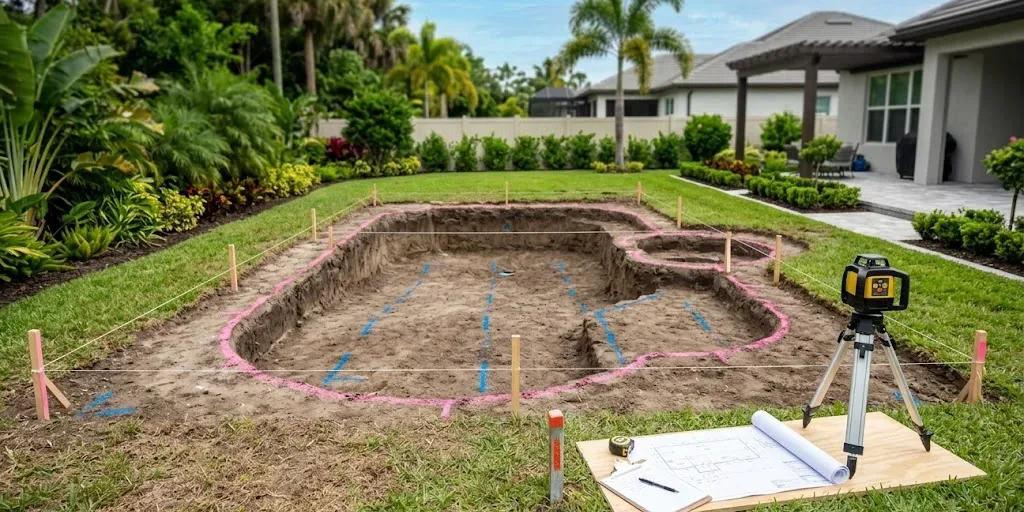
Building a swimming pool in Florida starts long before excavation. A qualified pool contractor needs to determine whether the property can physically, legally, and safely accommodate the pool you have in mind.
That means looking at more than pool size and shape. With Sunsation Pools & Spas, Inc., the contractor may need to evaluate the available yard space, property lines, setbacks, existing structures, utilities, drainage, access for construction equipment, flood-zone considerations, and the location of other site features. In Pinellas County, pools and spas are specifically included among residential projects requiring permitting, and local requirements can vary depending on whether the property is in unincorporated Pinellas County or within a municipality such as St. Petersburg, Clearwater, or Largo.
For homeowners across Pinellas County and the greater Tampa Bay area, this early site evaluation is one of the most important parts of the pool-building process. A design that looks perfect on paper may need to change once the contractor sees the actual property.
Key Takeaways
- A pool contractor checks the available building area before finalizing the pool design.
- Property lines, setbacks, easements, zoning, existing structures, and other site restrictions can affect where a pool can go.
- Utilities and underground conditions need to be considered before excavation begins.
- Flood-zone requirements can add another layer of review for properties in vulnerable areas.
- Pool safety requirements and permitting are part of the planning process, not something to address after construction starts.
- A good site evaluation helps identify potential construction problems before they become expensive changes.
What Does a Pool Contractor Check Before Building a Pool?
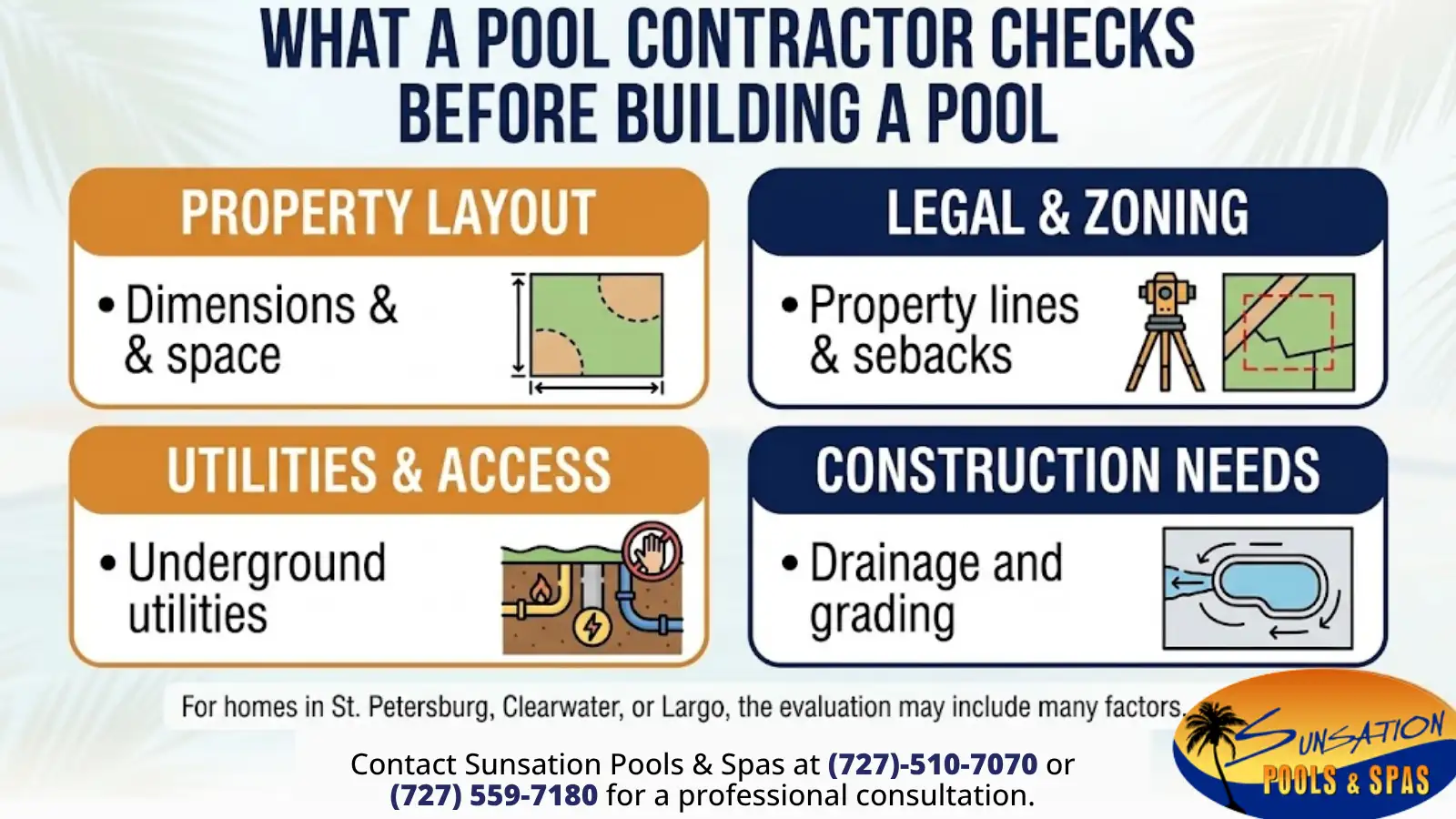
A pool contractor typically evaluates the property, proposed pool location, permitting requirements, access, utilities, drainage, and construction constraints before excavation begins. The exact checklist depends on the property and local jurisdiction.
For a home in the St. Petersburg, Clearwater, or Largo area, the evaluation may include:
- Property dimensions and available yard space
- Property lines and required setbacks
- Zoning and applicable development regulations
- Easements and access restrictions
- Existing buildings and hardscapes
- Underground utilities
- Drainage and grading
- Flood-zone considerations
- Pool equipment location
- Electrical and plumbing requirements
- Construction access
- Pool safety requirements
- Permit and inspection requirements
(727)-510-7070 or (727) 559-7180
The important point is that these factors interact. Moving the pool a few feet can affect the equipment location, decking, drainage, access, and even whether the proposed layout complies with applicable setbacks.
How Does a Pool Contractor Determine Where the Pool Can Go?
The first question is usually not, “What shape of pool do you want?”
It is, “Where can a pool legally and practically fit on this property?”
The contractor needs enough information to establish the buildable area. A property survey or site plan can help identify property boundaries, existing improvements, easements, and other features that influence the proposed pool location.
Local zoning matters as well, and it varies by municipality. St. Petersburg, Clearwater, and Largo each maintain their own zoning and land development regulations, so the applicable rules depend on which jurisdiction the property sits in.
Why Property Lines Matter
A pool cannot simply be placed wherever there appears to be open yard space.
The contractor needs to distinguish the usable yard from the legally available construction area. A narrow side yard, irregular lot, waterfront property, easement, or existing structure can significantly reduce the space available for a pool.
For example, an older Pinellas County property may have a backyard that appears large enough for a pool but becomes much tighter once setbacks and existing improvements are considered.
What About Pool Setbacks?
Setback requirements depend on the applicable local regulations and the property, and they are not the same in every direction.
In St. Petersburg, for example, code and zoning case records show side and rear yard setbacks for in-ground pools are commonly around 5 feet from the property line in several residential zoning districts, though this can be reduced further only through an approved variance. Front yard setbacks are typically much larger, often in the range of 25 to 30 feet depending on the zoning district, since pools are treated as accessory structures that generally must sit behind the front line of the house.
That does not mean every Florida property has the same setback requirement, or that side, rear, and front setbacks are all equal. Your contractor should verify the requirements that apply to your specific parcel and zoning district before finalizing the layout.
Does a Pool Contractor Check for Easements?
Yes, easements can be an important part of pool planning.
An easement gives another party certain rights to use a portion of the property for a particular purpose. Depending on the property, an easement may relate to utilities, drainage, access, or other infrastructure.
A pool, deck, retaining feature, or equipment pad placed in the wrong location can create a permitting or construction problem if it interferes with an easement.
This is one reason a site plan should be reviewed before construction begins rather than assuming that every part of the backyard is available to build on.
How Are Underground Utilities Checked Before Pool Excavation?
Underground utilities are another major consideration before digging.
A pool excavation can involve substantial earthwork, so the contractor needs to account for known utility locations and the requirements for locating underground services before excavation.
This may include:
- Electrical services
- Water lines
- Sewer connections
- Gas lines
- Irrigation systems
- Communication lines
- Pool-related existing plumbing
- Other buried infrastructure
Pinellas County properties are also subject to Sunshine 811 requirements for certain digging-related work.
The exact utility-locating process depends on the project, but the broader principle is simple: underground conditions should be understood before excavation starts.
Does a Pool Contractor Check Drainage and Grading?
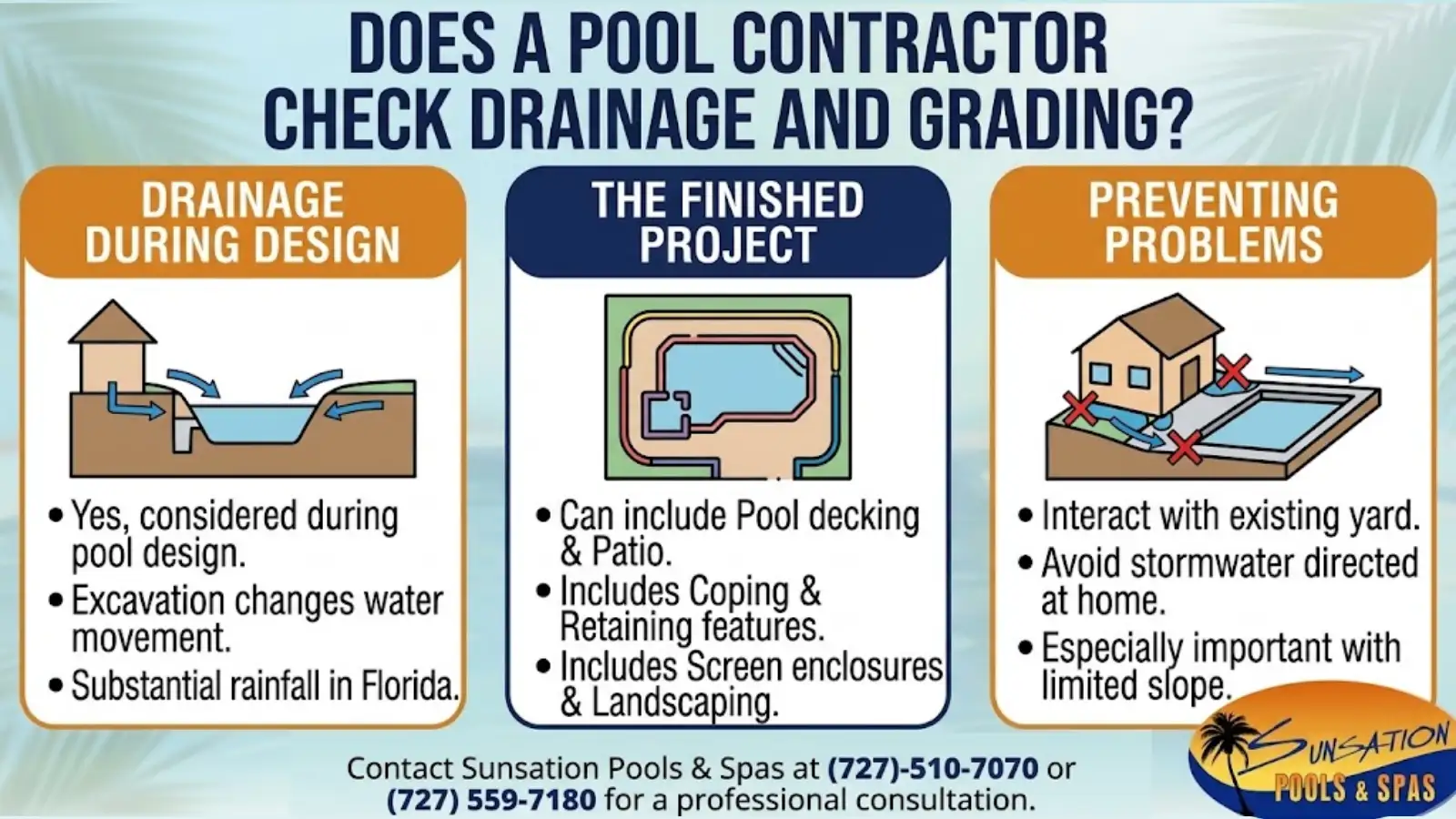
Yes. Drainage should be considered during pool design because excavation changes the way water moves across the property.
Florida properties can receive substantial rainfall, and a pool project may involve more than digging a hole. The finished project can include:
- Pool decking
- Patio areas
- Coping
- Retaining features
- Equipment pads
- Screen enclosures
- Landscaping
- Drainage improvements
The contractor needs to consider how the completed pool area will interact with the existing yard.
A pool should not create a situation where stormwater is directed toward the home, trapped against structures, or otherwise creates a drainage problem.
This is especially important on properties where the existing yard already has limited slope or drainage capacity.
(727)-510-7070 or (727) 559-7180
What Does Flood Zone Status Have to Do With Building a Pool?
Flood-zone status can affect the planning and permitting process.
Pinellas County states that construction in a flood zone can be subject to special building regulations and substantial-improvement requirements. The county advises property owners to review floodplain construction requirements before beginning applicable work.
For a pool project, this means flood considerations should be identified early rather than after the design has already been finalized.
Waterfront and low-lying properties can present additional complications. A pool contractor may need to coordinate the proposed pool location with existing seawalls, property boundaries, drainage features, and other site conditions.
Does Soil or Ground Condition Matter When Building a Pool?
The visible yard does not tell the whole story about what is below it.
Excavation can reveal conditions that were not obvious during the initial design. The contractor needs to consider the property’s existing ground conditions and whether additional engineering or construction measures may be necessary.
This is particularly important when the proposed pool is near:
- Existing foundations
- Seawalls
- Retaining walls
- Other structures
- Areas with unusual grade changes
- Underground infrastructure
The closer a pool is to another structure, the more important the relationship between the excavation and surrounding construction becomes.
A contractor should identify these potential conflicts during planning rather than discovering them after excavation has started.
How Does the Contractor Plan for Pool Equipment?
The pool itself is only one part of the project.
The finished system may require equipment such as pumps, filtration equipment, heaters, automation components, and associated electrical and plumbing connections.
The equipment area needs to be practical for installation, operation, service, and maintenance.
The contractor may consider:
- Distance from the pool
- Available equipment-pad space
- Electrical access
- Plumbing routes
- Drainage
- Noise considerations
- Service accessibility
- Relationship to the house and property boundaries
A beautifully designed pool can become frustrating if the equipment is squeezed into an inaccessible location.
This is where good planning matters. The equipment area should be considered as part of the pool design rather than treated as an afterthought.
What About Electrical and Plumbing Requirements?
A pool combines several construction trades.
Depending on the design, the project can involve structural pool construction along with plumbing, electrical work, equipment installation, drainage, and other site work.
Pinellas County identifies pools and spas as residential permit types and separately identifies plumbing, electrical, gas, and other trade work within its permitting system.
The contractor therefore needs to understand how these systems will work together before construction begins.
For example, the pool’s equipment location influences plumbing runs. Equipment selection affects electrical requirements. Heating equipment can introduce additional considerations. Automation adds another layer of controls and connections.
Good pool construction coordinates these systems from the beginning.
What Pool Safety Requirements Are Checked?
Residential pool construction in Florida also involves safety requirements.
Pinellas County requires a Residential Pool/Hot Tub/Spa Safety Act acknowledgement for applicable new pool, hot tub, and spa installations. The county states that the contractor uses this acknowledgement to confirm compliance with the safety requirements in Chapter 315 of the Florida Statutes.
Safety planning can include considerations involving:
- Pool barriers
- Gates and access
- Door and opening protection
- Safety features
- Pool location
- Required inspections
The specific requirements depend on the project and applicable code.
The important takeaway for homeowners is that safety is part of the design and permitting process. It should not be treated as something to figure out after the pool is finished.
How Does Permitting Affect Pool Construction in Florida?
Permitting is one of the reasons a pool project should be planned carefully before work begins.
Pinellas County lists both above-ground and in-ground pools and spas among its residential permit types. The county also requires plans and supporting documents appropriate to the project and notes that flood-zone requirements may apply.
The permitting authority also matters.
A property in unincorporated Pinellas County may go through the county’s building and development review process, while a property within St. Petersburg, Clearwater, or Largo may be subject to that city’s own permitting and zoning requirements.
That distinction matters because one identical permitting checklist does not apply to every property in Florida.
Your pool contractor should determine which jurisdiction has authority over the property and what documentation is required for that specific project.
What Should a Homeowner Have Ready Before Meeting a Pool Contractor?
You do not need to know every technical detail before contacting a contractor. However, having basic property information available can make the design process easier.
Useful information includes:
- Property address
- Existing survey, if available
- Existing site plans
- Information about septic systems, if applicable
- Existing pool or spa information
- Known easements
- Preferred pool location
- Desired pool size and features
- Desired decking or hardscape
- Heating or cooling preferences
- Automation preferences
- Any planned landscaping or outdoor structures
The more complete the starting information, the easier it is to identify constraints before committing to a final design.
What Can Cause a Pool Design to Change After the Initial Site Visit?
A preliminary pool concept can change when the contractor identifies a physical or regulatory constraint.
Common reasons include:
Limited Setback Space The homeowner may want a larger pool than the available buildable area allows.
Easements A utility or drainage easement may restrict where construction can occur.
Existing Structures The house, garage, retaining walls, seawalls, decks, or other improvements may limit the available footprint.
Equipment Location A proposed pool may fit physically but leave inadequate space for practical equipment installation.
Drainage The original design may need modification to maintain appropriate drainage around the finished project.
Flood Considerations Flood-zone requirements may influence the construction approach or documentation.
Construction Access A pool design that looks feasible may be difficult to construct if excavation equipment cannot reach the work area efficiently.
This is why a site evaluation is more than measuring the backyard. It is a process of identifying the relationships between the proposed pool and everything already on the property.
Why Construction Access Matters More Than Homeowners Expect
Pool construction requires getting materials and equipment to the work area.
The contractor may need to consider:
- Driveway access
- Side-yard width
- Gates
- Fences
- Landscaping
- Overhead obstructions
- Location of the house
- Location of neighboring structures
- Equipment staging
A tight-access property can require a different construction plan from a wide-open backyard.
Access can also influence scheduling, site protection, material handling, and the amount of disruption to the property.
A contractor who identifies access limitations early has more opportunity to plan around them.
How Can You Tell If a Pool Contractor Is Thorough?
A thorough pool contractor should be willing to discuss the property itself, not just the pool’s appearance.
Ask questions such as:
- Where can the pool legally be located?
- What setbacks apply to my property?
- Are there easements that affect the design?
- How will underground utilities be addressed?
- Is the property in a flood zone?
- Where will the pool equipment go?
- How will drainage be handled?
- How will construction equipment access the backyard?
- What permits are required?
- What inspections will be required?
- Are additional engineering documents needed?
The answers should be specific to your property.
Be cautious of a process that jumps directly from “What size pool do you want?” to a final price without adequately evaluating the site.
Pinellas County also advises consumers to verify a contractor’s license status before hiring and provides a contractor search resource for this purpose.
Why Local Experience Matters for Pool Construction in Pinellas County
Pool construction in Florida is not simply about installing a pool shell.
The property itself determines many of the decisions.
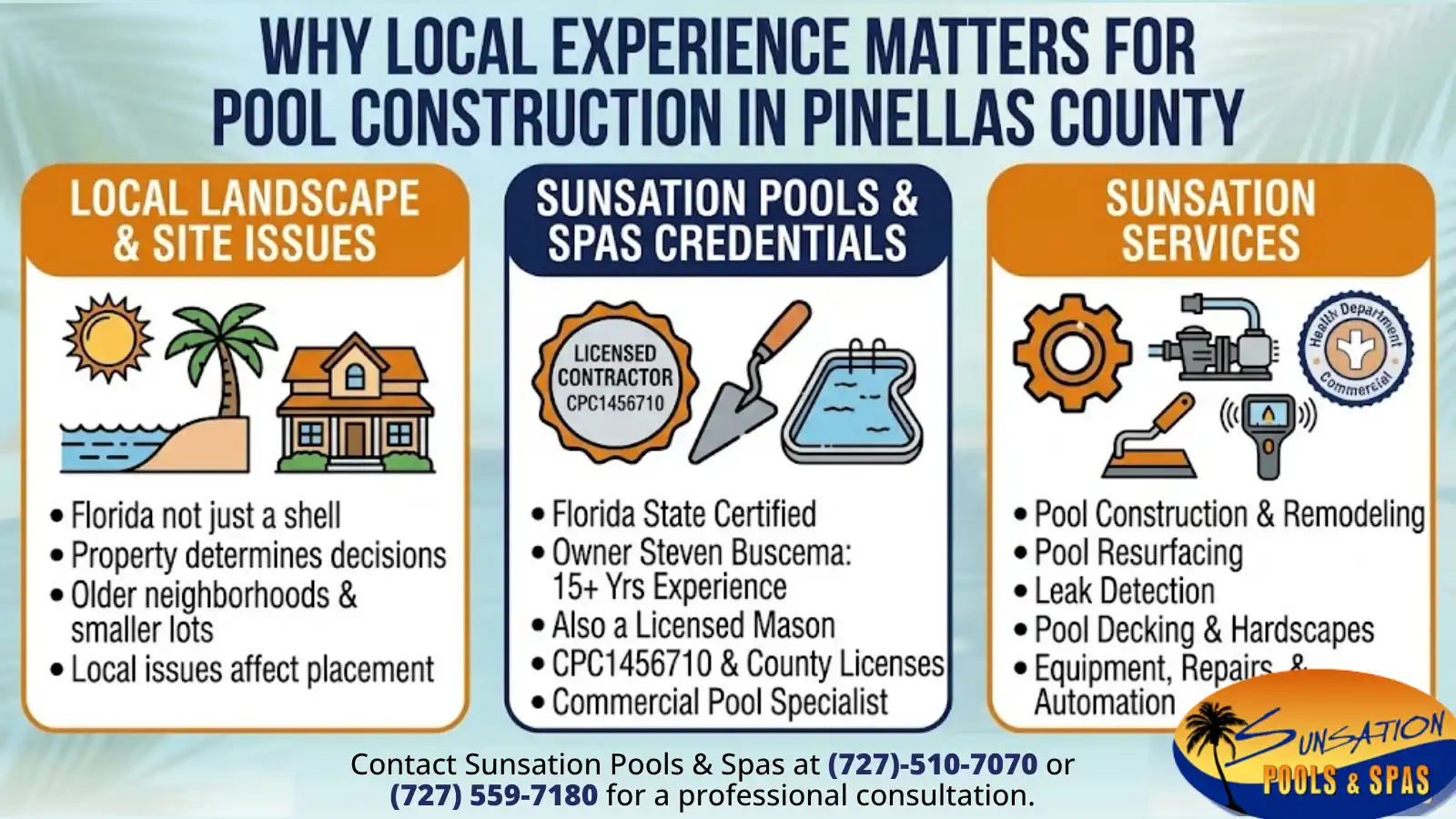
St. Petersburg, Clearwater, Largo, and the surrounding Tampa Bay area include older neighborhoods, waterfront properties, smaller residential lots, newer developments, and properties with different site constraints. Local experience helps a contractor recognize the types of issues that can affect pool placement and construction planning.
Sunsation Pools & Spas, Inc. is a Florida State Certified Commercial and Residential Pool Contractor serving Clearwater, Largo, and the greater Tampa Bay area, including St. Petersburg. The company is owned and operated by Steven Buscema, who has more than 15 years of experience in pool renovation and construction and is also a licensed mason.
Sunsation Pools & Spas holds Florida State Contractor License CPC1456710 and County License C-10108.
Our work includes:
- Pool Construction
- Pool Remodeling
- Pool Resurfacing
- Leak Detection
- Pool Decking & Hardscapes
- Pool Equipment & Repairs
- Pool Automation, Heating & Cooling
For commercial projects, Sunsation Pools & Spas also specializes in commercial pool and spa construction and renovation, working with health departments through the project and final inspection.
(727)-510-7070 or (727) 559-7180
What Is the First Step Before Building a Pool?
The first practical step is a property evaluation.
Before choosing the final pool shape, size, features, and finishes, the contractor should understand the site constraints. That means looking at the property layout, applicable regulations, utilities, drainage, access, equipment location, safety requirements, and permitting considerations.
Once those constraints are understood, the pool can be designed around the property instead of forcing the property to fit an unrealistic design.
That approach can save homeowners from expensive redesigns and construction surprises later.
Build the Pool Around Your Property, Not the Other Way Around
A successful pool project starts with understanding the property.
The right pool contractor looks beyond the pool’s appearance to the conditions that determine whether the project will work in the real world. Setbacks, utilities, drainage, flood considerations, equipment, access, safety, and permitting all have a place in the planning process.
For homeowners in Clearwater, Largo, St. Petersburg, and the greater Tampa Bay area, Sunsation Pools & Spas, Inc. provides pool construction, remodeling, resurfacing, equipment, hardscape, and related pool services.
To discuss your project, Contact us today at (727) 510-7070 and schedule a consultation with Sunsation Pools & Spas.
Frequently Asked Questions
Q: What does a pool contractor inspect before building a pool in Florida?
A: A pool contractor typically reviews the proposed pool location, property boundaries, setbacks, zoning, easements, existing structures, utilities, drainage, flood considerations, construction access, equipment location, safety requirements, and permitting needs.
Q: Do I need a permit to build an in-ground pool in Florida?
A: In Pinellas County, in-ground pools and spas are listed as residential permit types. Requirements can vary by jurisdiction and property, so homeowners should confirm the applicable requirements with the responsible building department and their contractor.
Q: How far does a pool have to be from a property line in Pinellas County?
A: The applicable setback depends on the property’s zoning district and which side of the property is in question. In several St. Petersburg residential zoning districts, side and rear setbacks for in-ground pools commonly run around 5 feet, while front yard setbacks tend to be far larger, often 25 feet or more. Always verify the current requirements for your specific property and municipality.
Q: Does flood-zone status affect pool construction?
A: It can. Pinellas County states that properties in flood zones may be subject to special building regulations and substantial-improvement requirements. The applicable requirements should be evaluated before construction begins.
Q: Does a pool contractor check underground utilities?
A: Underground utilities and existing buried systems should be considered before excavation. The specific locating and notification requirements depend on the project and jurisdiction.
Q: Where should pool equipment be located?
A: Pool equipment should be placed where there is adequate space for installation, plumbing and electrical connections, operation, and future service. The best location depends on the property and the pool’s design.
Q: Why does construction access matter when building a pool?
A: Excavation and material delivery require access to the construction area. Narrow side yards, fences, landscaping, structures, and overhead obstacles can affect how equipment and materials reach the backyard and may influence the construction plan.
Q: How do I choose a pool contractor in Pinellas County?
A: Look for an appropriately licensed contractor with relevant residential pool experience and ask how they handle site evaluation, permits, utilities, drainage, equipment, safety requirements, and construction access. Pinellas County recommends verifying contractor licensing before hiring.