

(727)-510-7070 or (727) 559-7180
Determining whether your swimming pool has a structural breach or is simply experiencing normal evaporation requires a close look at your daily water loss. Standard Florida sun and coastal breezes naturally lower water levels. However, when you find yourself topping off the pool constantly, active plumbing or shell damage is usually the culprit. Sunsation Pools & Spas, Inc. offers professional leak detection alongside full pool construction, remodeling, resurfacing, and equipment repair across St. Petersburg and Pinellas County. If you are asking how can you tell if your pool is leaking, starting with systematic diagnostic testing will save you thousands in structural damage.
Key Takeaways
- Track Water Level Drops: A pool dropping faster than normal evaporation rates indicates an active leak.
- Conduct a Bucket Test: Isolate thermal evaporation from structural water loss using an easy 24-hour baseline test.
- Inspect Key System Components: Inspect skimmers, return lines, pump fittings, light niches, and mechanical equipment pad connections.
- Perform Targeted Dye Testing: Draw localized leak detection dye into structural hairline cracks or tile line separations while the water sits completely still.
- Hire Local Pinellas Experts: Call Sunsation Pools & Spas, Inc. at Call (727) 510-7070 for precision leak location and equipment repairs.
What Are the Early Warning Signs of a Swimming Pool Leak?
Persistent water loss that forces you to add water constantly is the single clearest indicator of an underlying pool leak. While high temperatures and dry winds pull moisture from open water daily, steady drops during non-use periods signal an structural or mechanical breach.
The reality on the ground is that water takes the path of least resistance. A visible wet patch near your equipment pad rarely pinpoints the exact site of origin because subsurface plumbing trenches channel water across the yard before it surfaces.
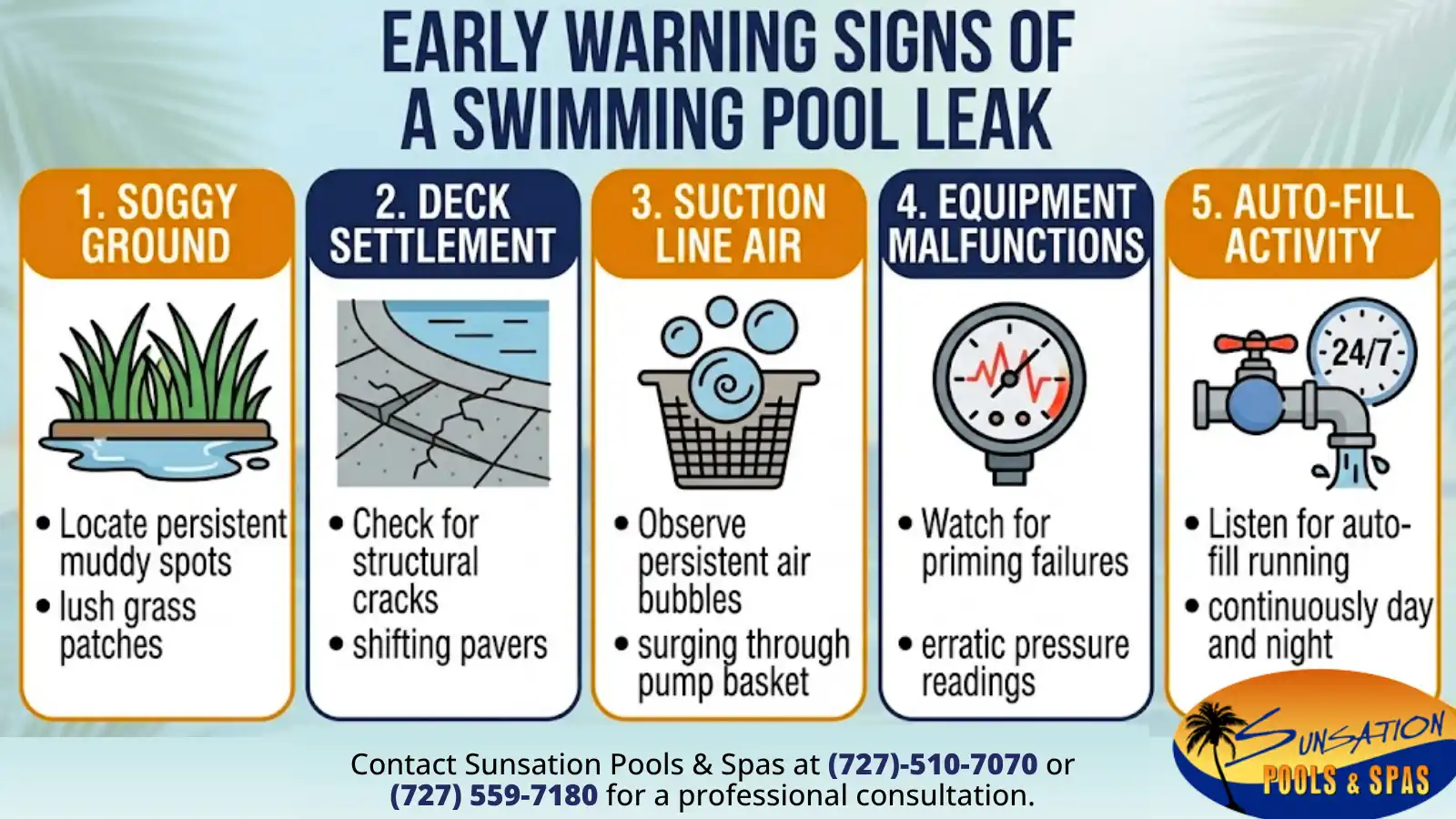
- Soggy Ground: Locate persistent muddy spots or lush grass patches near the equipment pad or pool deck.
- Deck Settlement: Check for structural cracks, shifting pavers, or sinking concrete slabs around the pool border.
- Suction Line Air: Observe persistent air bubbles surging through your pump basket or returning through the pool jets.
- Equipment Malfunctions: Watch for priming failures or erratic pressure readings on filter tank pressure gauges.
- Auto-Fill Activity: Listen for automatic water leveling valves running continuously day and night.
(727)-510-7070 or (727) 559-7180
- and night.
Where Do Leak Problems Most Frequently Develop Around Your Pool?
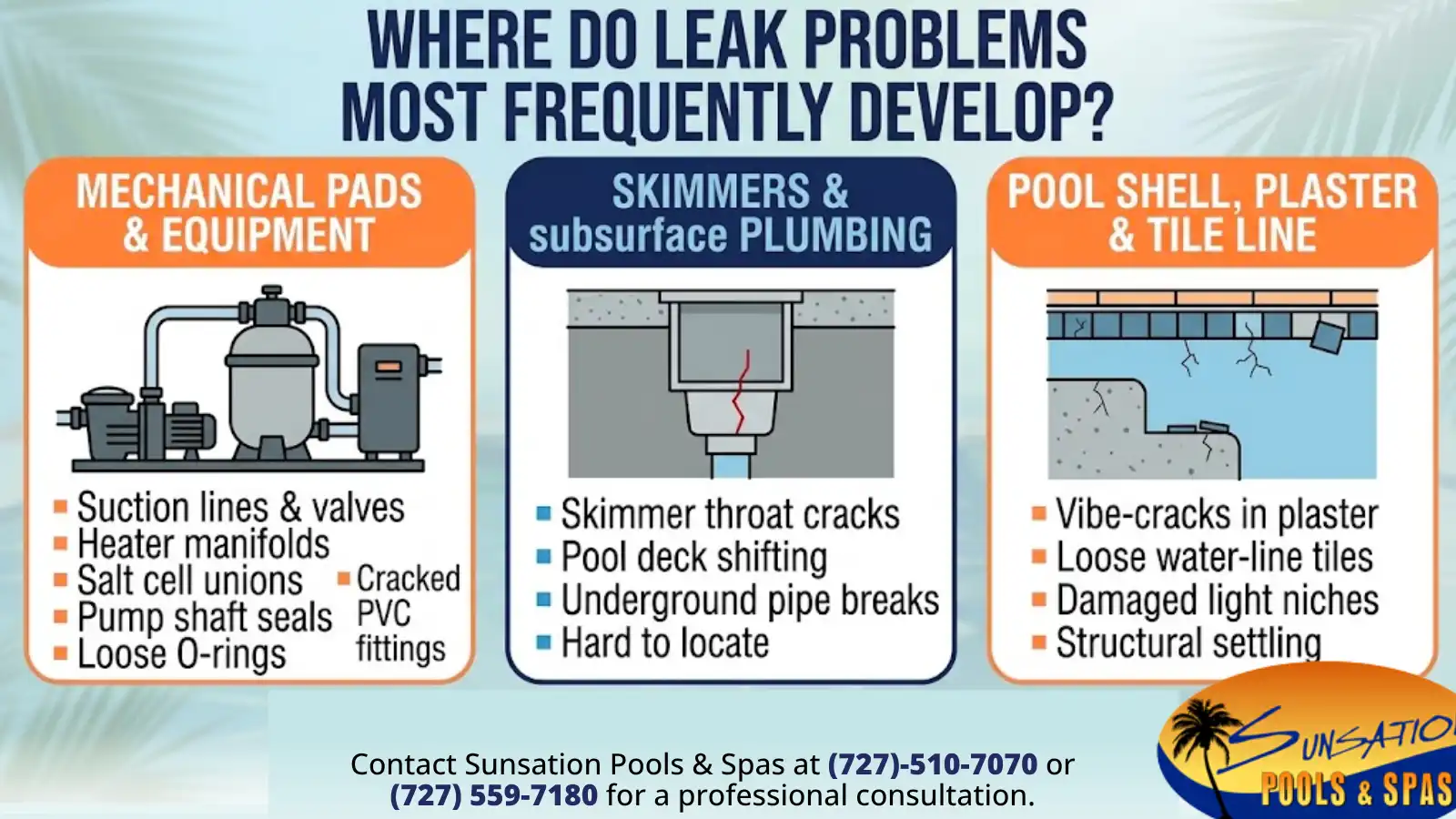
Pool leaks typically form within the filtration equipment, along buried return lines, around skimmer throats, or through shell cracks. Inspecting accessible mechanical pads and surface connections helps rule out minor seals before digging into underground lines.
Mechanical Pads and Equipment Connections
Examine all suction lines, filter valves, heater manifolds, salt cell unions, and pump shaft seals. Loose O-rings or cracked PVC fittings allow fluid to escape under operational pressure. Sunsation Pools & Spas, Inc. handles full equipment repair across St. Petersburg, servicing pumps, filters, salt systems, automation units, and heaters.
Skimmers and Subsurface Plumbing
The plastic throat where your skimmer connects to the concrete shell frequently cracks from pool deck shifting. Underground pipe breaks are far trickier to locate without specialized acoustic gear or pressure testing.
Pool Shell, Plaster, and Tile Line
Vibe-cracks in plaster, loose water-line tiles, damaged light niches, or structural settling allow water out. However, a surface line crack doesn’t guarantee an active leak without verification.
(727)-510-7070 or (727) 559-7180
The Step-by-Step Pool Owner’s Diagnostic Guide
Here’s the part most contractors won’t tell you: simple diagnostic steps pinpoint whether you need a plumber or a equipment tune-up long before you pay for heavy excavation.
- Isolate Automatic Water Systems
- Turn off all auto-fill valves, automatic fill lines, and drip hoses.
- Ensure no fresh water enters the system during your monitoring window.
- Set Up the Bucket Test Baseline
- Position a 5-gallon bucket on the second step of your pool, submerging its lower portion.
- Fill the bucket with pool water until the inner water level matches the outer pool line.
- Mark and Track Levels
- Mark the bucket’s internal water level with electrical tape or a waterproof marker.
- Mark the external pool water level on the outside of the bucket.
- Evaluate Results After 24 Hours
- Keep the pool pump running in its normal cycle for 24 hours.
- Measure both water drops; if the pool loses significantly more than the bucket, you have an active leak.
Common Causes of Homeowner Water Loss
| Loss Factor | Evaporation | Structural/Plumbing Leak |
| Typical Daily Rate | 1/8 to 1/4 inch per day | Exceeds 1/4 inch per 24 hours |
| Weather Influence | Driven by St. Petersburg heat, humidity, and wind | Unaffected by atmospheric changes |
| Equipment Impact | Equal loss whether pump is ON or OFF | Loss rate changes depending on pump operation |
| Yard Condition | Normal soil conditions around deck | Unexplained wet spots or shifting pavers |
| Solution | Solar covers or liquid evaporation blankets | Professional leak detection and repair |
Important Terms to Know
- Skimmer Faceplate: The plastic housing where your pool shell meets the suction plumbing line.
- Hydrostatic Valve: A relief valve inside the main drain designed to prevent ground water pressure from popping the pool.
- Pressure Testing: A diagnostic process where plumbing lines are isolated and pressurized with air to locate underground breaks.
- Light Niche: The submerged fixture housing your pool lights, which often leaks where the conduit pipe exits the back.
How Can Precision Dye Testing Help Locate the Exact Break?
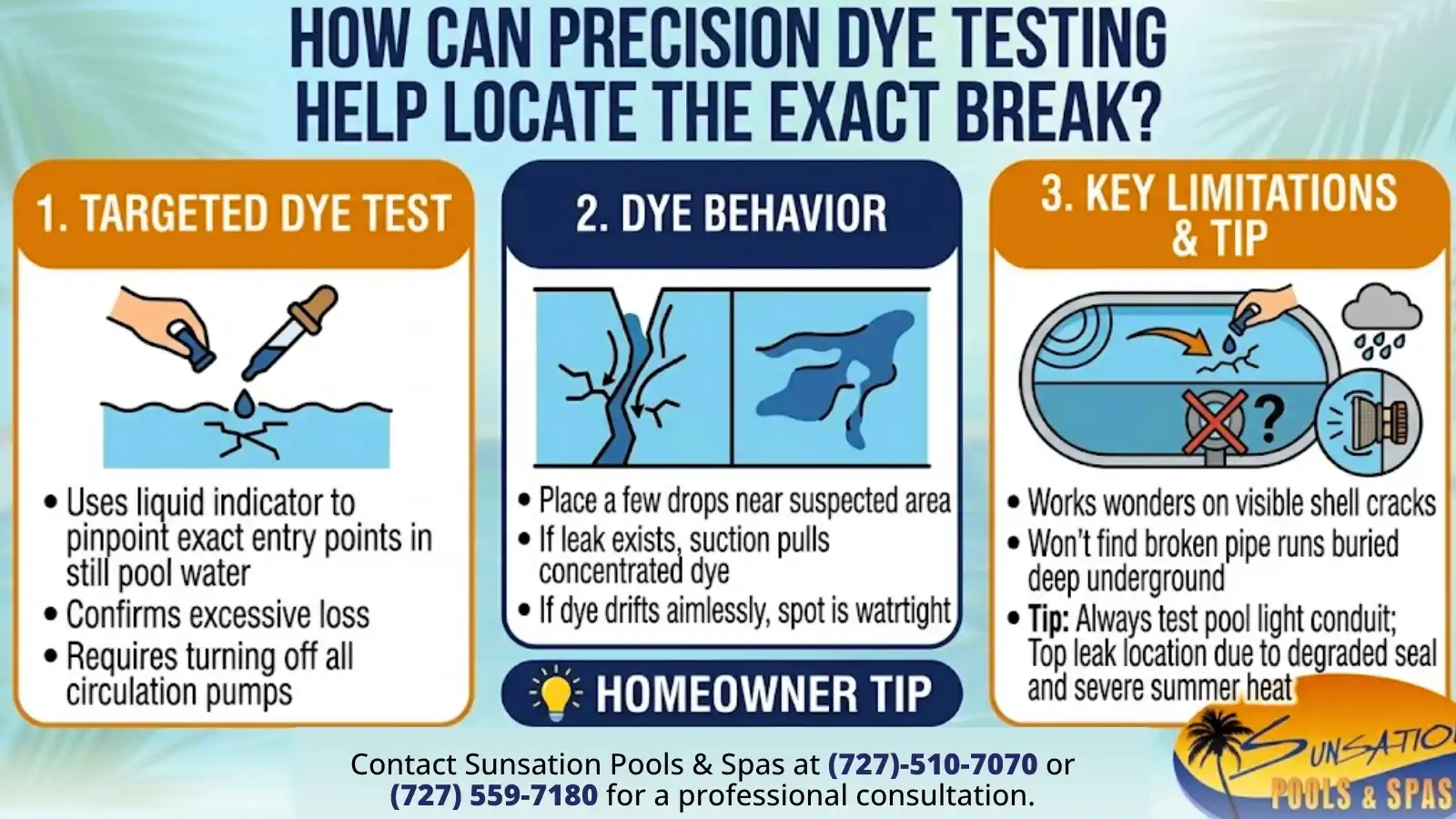
A targeted dye test uses heavy liquid indicator to pinpoint exact entry points in still pool water. Once the bucket test confirms excessive loss, turning off all circulation pumps allows you to check suspected cracks, skimmer seams, and light niches directly.
Place a few drops of specialized pool leak detection dye inches away from a suspected area. If a leak exists, the suction pulls the concentrated dye right out of the pool shell. If the dye drifts aimlessly, that specific spot is watertight. Dye testing works wonders on visible shell cracks but won’t find broken pipe runs buried deep underground.
💡 Homeowner Tip: Always test your pool light conduit during a dye test. The rubber grommet sealing the wire conduit behind the light fixture degrades over time due to localized 4 p.m. Pasco and Pinellas County rain deluges and severe summer heat, making light niches one of Florida’s top leak locations.
(727)-510-7070 or (727) 559-7180
Ready to Fix Your St. Petersburg Pool Leak?
Ignoring unexplained water loss ruins surrounding soil stability, drives up utility bills, and starves your pump motor of water. Unchecked water loss damages expensive filtration equipment and destabilizes pool decks over time.
Sunsation Pools & Spas, Inc. provides comprehensive leak detection, resurfacing, deck remodeling, and equipment repair across Pinellas County. Protect your investment and stop wasting water today by contacting our team.
- Schedule an Inspection: Call our office to set up a comprehensive site visit.
- Diagnostic Evaluation: Our technicians perform acoustic line testing and pressure isolation.
- Targeted Repair: We fix broken plumbing, seal light niches, or repair surface cracks quickly.
Reach out to Sunsation Pools & Spas, Inc. at (727) 510-7070 today to stop your leak and restore your pool. Visit our website and contact us today!
Frequently Asked Questions
Q: How much water loss from a pool is considered normal?
A: Normal evaporation claims between 1/8 to 1/4 inch of water daily depending on local heat, humidity, and wind conditions. Any loss consistently exceeding 1/4 inch per day points toward an active plumbing or structural defect.
Q: Can a pool leak cause the water level to keep dropping continuously?
A: Yes, active leaks cause continuous water loss regardless of whether the pool pump is running or turned off. If your water level drops past the skimmer line and keeps falling, you have an open leak in the shell, light niche, or main drain.
Q: Can I locate a pool leak without hiring a professional?
A: You can perform visual inspections, run a bucket test, and use dye near surface cracks or skimmer throats. However, pinpointing leaks inside buried PVC pipes or under concrete decks requires professional sonic detection equipment.
Q: Where do pool leaks develop most frequently?
A: Leaks occur most often around skimmer throats, return line fittings, light niche conduits, pump mechanical seals, and aging plaster cracks. Ground movement and chemical wear gradually weaken these connection points over time.
Q: Does a dye test always find the source of a pool leak?
A: No, dye tests only work when you place the indicator near an accessible crack while the pool water is completely still. It cannot locate underground pipe breaks, main drain line leaks, or leaks hidden behind heavy algae growth.